file /opt/antigravity/icon.pngI wrote the abstract, and GPT generated the image.
1. Outer Measure on
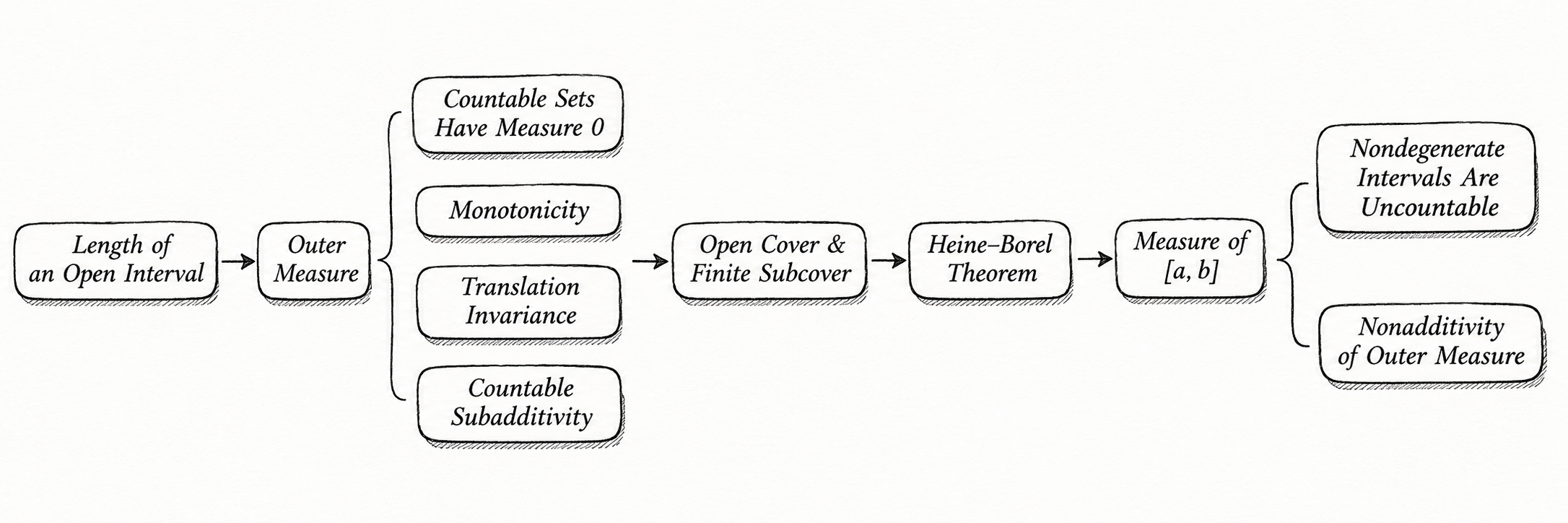
We begin by defining the length of an open interval and then introduce outer measure, establishing several fundamental properties:
- Countable sets have outer measure zero.
- Monotonicity of outer measure.
- Translation invariance of outer measure (after defining translation).
- Countable subadditivity of outer measure.
Next, we study the outer measure of closed intervals. We first recall open covers and finite subcovers, as introduced in functional analysis, and revisit the Heine–Borel theorem (which follows from a more general result we previously proved). Using this theorem, we show that
As an immediate consequence, every nondegenerate interval is uncountable.
Finally, we demonstrate that outer measure is not additive, using the Axiom of Choice.
2. Measurable Spaces and Functions
σ-Algebras
We begin by proving the impossibility of extending the notion of length to all subsets of while preserving countable additivity and translation invariance. Thus, rather than giving up either of these desirable properties, we restrict the collection of subsets on which a measure is defined.
This motivates the definition of a σ-algebra. We then establish some elementary properties of σ-algebras, particularly their closure under countable intersections and set differences.
With this structure, we introduce the notions of a measurable space and an -measurable set.
Borel Subsets of
We prove the existence of the smallest σ-algebra containing any given collection of subsets of . Applying this result to the collection of all open subsets of , we define Borel sets.
Some important examples of Borel sets are:
- open and closed subsets of ;
- countable subsets of ;
- half-open intervals;
- the set of continuity points of an arbitrary function .
We also note that the collection of all Borel sets cannot be obtained through finitely many successive stages of taking countable unions, countable intersections, and complements.
Inverse Images
To discuss measurable functions, we first define the inverse image of a set and establish its algebraic properties:
- ;
- ;
- ;
- .
Measurable Functions
We introduce the notions of a measurable function and a characteristic function . These two notions are related by the observation that is measurable if and only if is measurable.
We then establish a useful criterion for measurability: a function is -measurable if and only if for every .
Next, we define a Borel measurable function, as well as increasing and strictly increasing functions. We show that continuous functions and increasing functions on Borel subsets of are Borel measurable.
Having established these basic examples, we investigate how measurability behaves under various operations:
- composition with Borel measurable functions;
- addition, subtraction, multiplication, and division (when the denominator is nowhere zero);
- taking pointwise limits of sequences of measurable functions.
Finally, we extend the notions of Borel sets and measurable functions to the extended real line , together with the corresponding criterion for measurability.
We conclude this section by proving that the pointwise infimum and supremum of a sequence of extended-real-valued measurable functions are themselves measurable.
Comparison with Mathematical Analysis
| Mathematical Analysis | Measure Theory |
|---|---|
| Topology | σ-algebra |
| Topological space | Measurable space |
| Open set | Measurable set |
| Continuous function | Measurable function |
| Length | Measure |
| Countable set | Null set |
| Step function | Simple function |
| Equality | Equality almost everywhere |
| Uniform convergence | Almost uniform convergence |
| Riemann integral | Lebesgue integral |
(note: some concepts will be discussed later)
We further compare topology and -algebra’s properties on union and intersection.
| Property | Topology | σ-algebra |
|---|---|---|
| Countable union | ✓ | ✓ |
| Countable intersection | ✗ | ✓ |
| Arbitrary union | ✓ | ✗ |
| Arbitrary intersection | ✗ | ✗ |
3. Measures and Their Properties
We define measure , whose essential property is countable additivity, and introduce several examples, including counting measure and Dirac measure. We then define a measure space .
From the definition of a measure, we derive several fundamental properties:
- Finite additivity;
- Monotonicity and the measure of a set difference;
- Countable and finite subadditivity;
- Measure of an increasing union;
- Measure of a decreasing intersection;
- Measure of a union of two sets.
In particular, the results concerning increasing unions and decreasing intersections establish the compatibility of measures with monotone limits of measurable sets.
4. Lebesgue Measure
Unlike outer measure, Lebesgue measure makes the following trade-off.
| Property | Outer Measure | Lebesgue Measure |
|---|---|---|
| Universal domain | ✓ | ✗ |
| Agreement with length | ✓ | ✓ |
| Countable additivity | ✗ | ✓ |
| Translation invariance | ✓ | ✓ |