无穷级数与无穷乘积是基础,讲了对常数项级数,如何进行分析与判断,这是我们后续学习的基础。前面其实我们已经讨论过了,直接上链接,回顾即可。
接下来进入函数序列。Apostol 首先介绍了逐点收敛,然后迅速把中心放到一致收敛的理论上了。之后,我们会重点讨论幂级数。
Deepseek 针对Apostol 的内容与 Part 1 做出如下评注(有修改)。
(A)一致收敛理论板块(§9.1–§9.13)
| 节号 | 标题 | 要点 |
|---|---|---|
| §9.2 | 实值函数序列的例子 | Apostol 会给出具体序列(如 在 上的收敛行为),用以区分逐点收敛与一致收敛。笔记缺具体例子 |
| §9.4 | 一致收敛与连续性 | 核心定理:若 连续且一致收敛到 ,则 连续。这在理论上极其重要,笔记只字未提 |
| §9.7 | 一条填满空间的曲线 | Peano 曲线——一致收敛可以构造出「填满正方形」的连续曲线。这是 Apostol 的经典亮点,笔记完全缺失 |
| §9.8 | 一致收敛与 Riemann-Stieltjes 积分 | 核心定理:若 且每个 ,则 且 。这是逐项积分的理论基石 |
| §9.9 | 可被逐项积分的非一致收敛序列 | Arzelà 控制收敛定理的雏形——说明一致收敛是逐项积分的充分但非必要条件。这一微妙之处笔记完全没涉及 |
| §9.10 | 一致收敛与微分 | 逐项求导的条件: 一致收敛 + 在某点收敛。笔记完全没涉及 |
| §9.12 | 一致收敛与二重序列 | 二重极限交换的条件,与一致收敛的深层联系。完全缺失 |
| §9.13 | 平均收敛 | 引入 范数下的收敛(),与一致收敛形成对比。你的笔记在傅里叶部分用到了 范数,但并未将之与 Apostol 的「平均收敛」一节对接 |
(B)幂级数板块(§9.14–§9.23)
| 节号 | 标题 |
|---|---|
| §9.14 | 幂级数 |
| §9.15 | 幂级数的乘法 |
| §9.16 | 代入定理 |
| §9.17 | 幂级数的倒数 |
| §9.18 | 实的幂级数 |
| §9.19 | 由函数生成的泰勒级数 |
| §9.20 | 伯恩斯坦定理 |
| §9.21 | 二项式级数 |
| §9.22 | 阿贝尔极限定理 |
| §9.23 | 陶伯定理 |
Part 2 将覆盖 (A)。
一、函数序列基础
1. Basic Definition
Apostol 在开篇便已经点出了逐点收敛以及一致收敛的定义以及需要讨论的问题,因为懒,所以直接搬过来:
This chapter deals with sequences whose terms are real- or complex-valued functions having a common domain on the real line or in the complex plane . For each in the domain we can form another sequence whose terms are the corresponding function values. Let denote the set of for which this second sequence converges. The function defined by the equation
is called the limit function of the sequence , and we say that converges pointwise to on the set .
Our chief interest in this chapter is the following type of question: If each function of a sequence has a certain property, such as continuity, differentiability, or integrability, to what extent is this property transferred to the limit function? For example, if each function is continuous at , is the limit function also continuous at ? We shall see that, in general, it is not. In fact, we shall find that pointwise convergence is usually not strong enough to transfer any of the properties mentioned above from the individual terms to the limit function . Therefore we are led to study stronger methods of convergence that do preserve these properties. The most important of these is the notion of uniform convergence.
Before we introduce uniform convergence, let us formulate one of our basic questions in another way. When we ask whether continuity of each at implies continuity of the limit function at , we are really asking whether the equation
implies the equation
But (1) can also be written as follows:
Therefore our question about continuity amounts to this: Can we interchange the limit symbols in (2)? We shall see that, in general, we cannot. First of all, the limit in (1) may not exist. Secondly, even if it does exist, it need not be equal to . We encountered a similar situation in Chapter 8 in connection with iterated series when we found that is not necessarily equal to .
The general question of whether we can reverse the order of two limit processes arises again and again in mathematical analysis. We shall find that uniform convergence is a far-reaching sufficient condition for the validity of interchanging certain limits, but it does not provide the complete answer to the question. We shall encounter examples in which the order of two limits can be interchanged although the sequence is not uniformly convergent.
这里是教材给出的经典反例: 连续,不代表 连续。
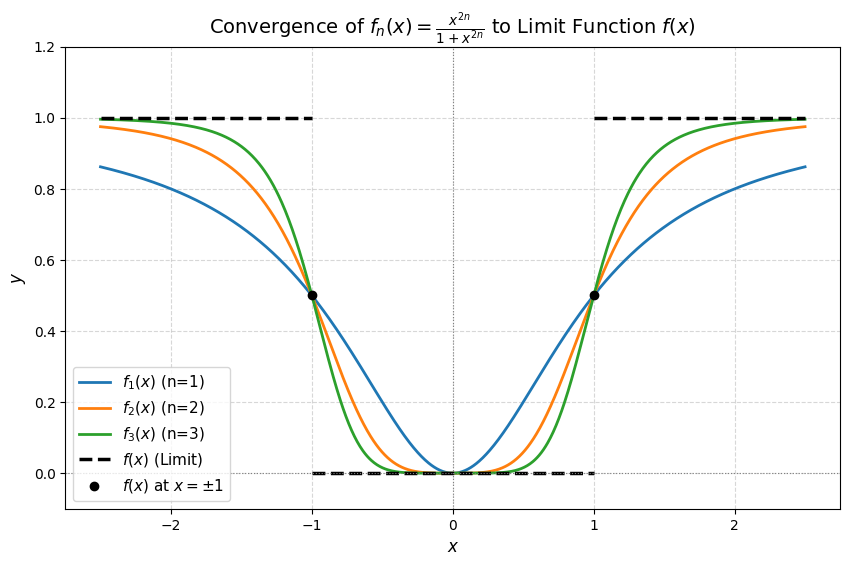
要想让极限函数也具备原函数序列良好的性质,我们需要一致收敛的概念。
此定义和数列的收敛很像,如下:
Def 是一个一致收敛于 的函数序列,即,对任意 ,存在 使得
2. Uniform Convergence and Continuity
TH 假定 在 上一致收敛于 ,且每一个 在 点连续. 则 在 点连续.
证明采用经典的 论证。
证明待补充
后面,作者马上讲了柯西条件,并且明确指出了把函数看成度量空间中的点这一思想。
3. Infinite Series of Functions
就像刚刚讨论级数一样,把函数看成点,自然得到函数项级数的概念。
Def 令 为一个定义在 上的函数序列,对于 ,定义
对于函数项级数的一致收敛,首先可以提出柯西收敛法则,接着是 M-test。同时注意到,连续性是可以传递的,故而,
二、函数序列的进一步性质
内容待补充